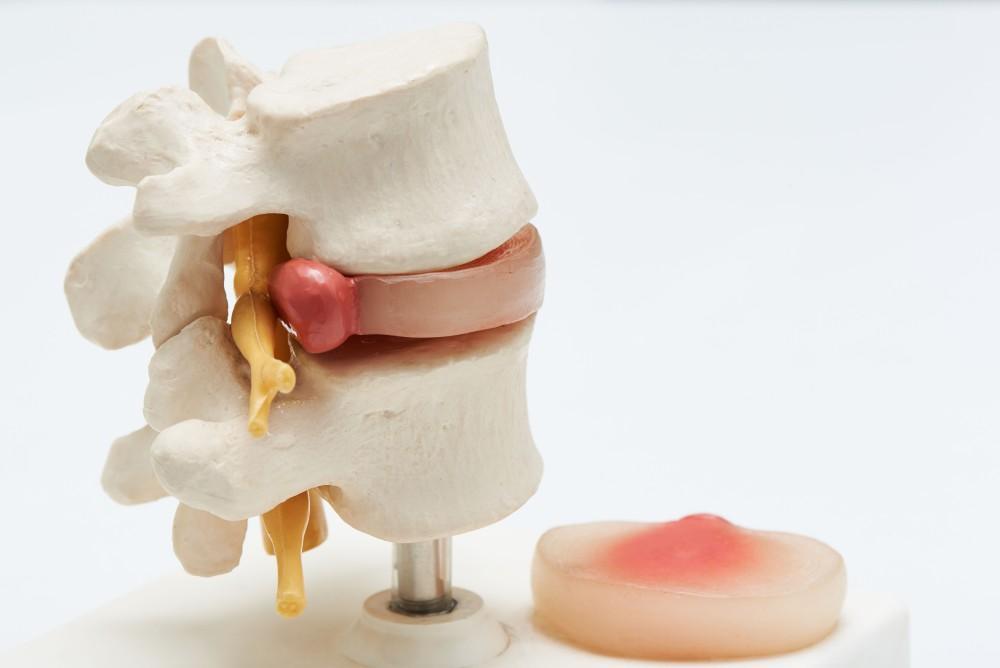
Your MRI report says you have a bulging disc. Or maybe it says “disc herniation,” “protrusion,” or “extrusion.”
It’s easy to read those words and assume something has gone seriously wrong with your spine. But disc findings are more nuanced than they sound. A bulging disc and a herniated disc describe different changes in a spinal disc, and neither diagnosis automatically tells us how much discomfort you have or what treatment you need.
At McNulty Spine in Las Vegas, Nevada, Patrick McNulty, MD, evaluates your imaging alongside your symptoms and neurological exam to determine what’s actually happening — and what, if anything, needs to be done.
First, a quick look at your spinal discs
Between most of the vertebrae in your spine are flexible discs that absorb shock and help your spine move. Each disc has a softer center surrounded by a tougher outer layer. Over time, normal aging and degeneration can change a disc’s shape and structure. Injury can also damage a disc.
Those changes can result in a bulge or herniation, but the terms aren’t interchangeable.
A bulging disc involves a broader area
With a bulging disc, the outer contour extends beyond its usual boundary over a relatively broad portion of the disc.
Think of gently pressing down on a hamburger bun. The edges may extend outward without one particular spot breaking through.
A bulging disc may develop as a disc loses height or changes with age. However, seeing one on an MRI doesn’t necessarily mean you’ve found the source of your back or neck pain. Disc bulges are common even in people who aren’t experiencing symptoms.
Problems are more likely when bulging tissue narrows the spinal canal or presses on a nearby nerve.
A herniated disc is more localized
A herniated disc involves a more focal displacement of disc material beyond its normal boundary.
Depending on the shape and extent of that displacement, your MRI report might use terms such as “protrusion” or “extrusion” to describe the herniation.
If displaced disc material irritates or compresses a nerve, symptoms can extend well beyond your spine. A herniated disc in your lower back may cause sciatica, with sharp or burning discomfort, numbness, tingling, or weakness traveling into a leg. A herniated cervical disc can produce similar symptoms in a shoulder, arm, or hand.
Does a herniated disc mean your problem is more serious?
Not necessarily: A disc deformation on an MRI doesn’t always match your symptom severity.
A relatively small herniation in just the wrong location can irritate a nerve and cause significant symptoms. Meanwhile, someone else may have a noticeable bulge and feel perfectly fine.
That’s why Dr. McNulty doesn’t treat an MRI finding in isolation. He looks at where you hurt, whether symptoms travel into an arm or leg, whether you have numbness or weakness, and whether the changes on your imaging match your symptoms.
Do bulging and herniated discs require different treatments?
Treatment depends less on the label and more on what the affected disc is actually doing.
When there isn’t a serious neurological deficit, conservative care is usually the first step for a symptomatic herniated disc. Depending on your condition, Dr. McNulty may recommend conservative pain management, such as activity modification, anti-inflammatory medication, physical therapy, or targeted injections.
Many people improve without an operation.
If symptoms persist despite conservative treatment or nerve compression is causing significant or progressive neurological problems, Dr. McNulty can consider surgical options based on the specific problem. His expertise includes minimally invasive surgery, such as decompression, artificial disc replacement, spinal fusion, and complex spinal reconstruction.
The goal is to choose the approach that adequately addresses the problem while preserving healthy tissue and function whenever possible.
Your MRI finding is only part of the answer
Whether your report says “bulging” or “herniated,” don’t let one word convince you that your spine is damaged beyond repair — or that the finding should simply be ignored.
What matters is whether that disc change explains what you’re experiencing.
If back or neck symptoms, radiating discomfort, numbness, or weakness are interfering with your life, contact McNulty Spine in Las Vegas to schedule an evaluation with Dr. McNulty. He can determine what’s causing your symptoms and recommend the level of treatment your spine actually needs.